Sunday, August 27, 2006

Flower Children Need Love, Too


Henry Shaw was an Englishman who moved to St. Louis, Missouri in the early nineteenth century and later became instrumental in establishing the Missouri Botanical Garden.

Shaw never married. His real love was his garden. A story is told that a lady visitor was amazed that he could remember so well the names of the garden’s rare plants. “Madam,” he is said to have replied, “did you ever know a mother who could forget the names of her children? These plants and flowers are my children. How can I forget them?”

Well, sad to say, if my flowers were my children, I’d probably be hauled into family court on the grounds of neglect.

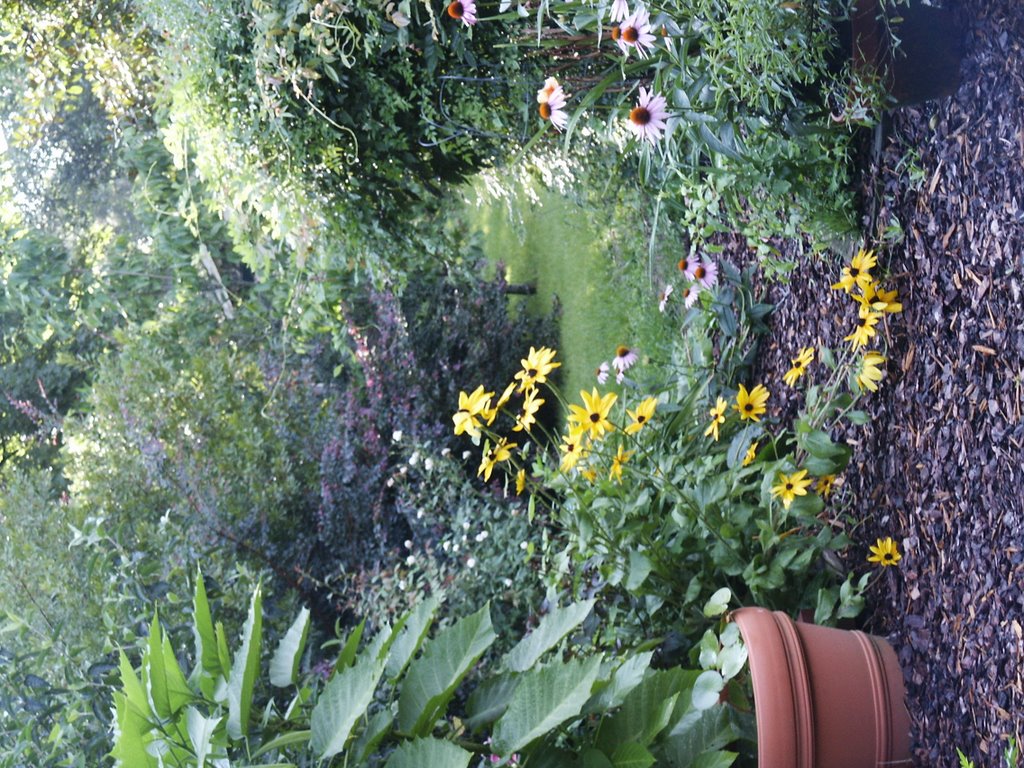
There are, fortunately, a few late summer bloomers that can take the heat and my periodic negligence. Purple Coneflower (Echinacea purpurea) is one of my favorite summer flowers with dusty pink daisy-like flowers that start blooming in mid-spring and keep right on into the fall. The dried flower heads bequeath hundreds of seeds that can be left to self seed or harvested and started in flats for next year’s bed. Go ahead and get them started now. Don’t wait until spring.

Shasta Daisies (Chrysanthemum X superbum) inhabit another corner of my side bed and are still going strong now in late August. Shasta daisy is a member of the Asteraceae family and is a hybrid created by Luther Burbank in 1890. The name “Shasta daisy” is said to come from the fact that the clean white petals of the daisy reminded Burbank of the snow on Mount Shasta in California. This cheerful, sun-loving, long-lasting daisy has white petals surrounding a yellow center atop sturdy stems that make it great for cutting. Leucanthemum ‘Becky’ was named the 2003 Perennial Plant of the Year by the Perennial Plant Association. Like the coneflower, it starts blooming in spring and will last into fall. Just give it sun, regular water, and keep it groomed. It will reward you with years of beauty.
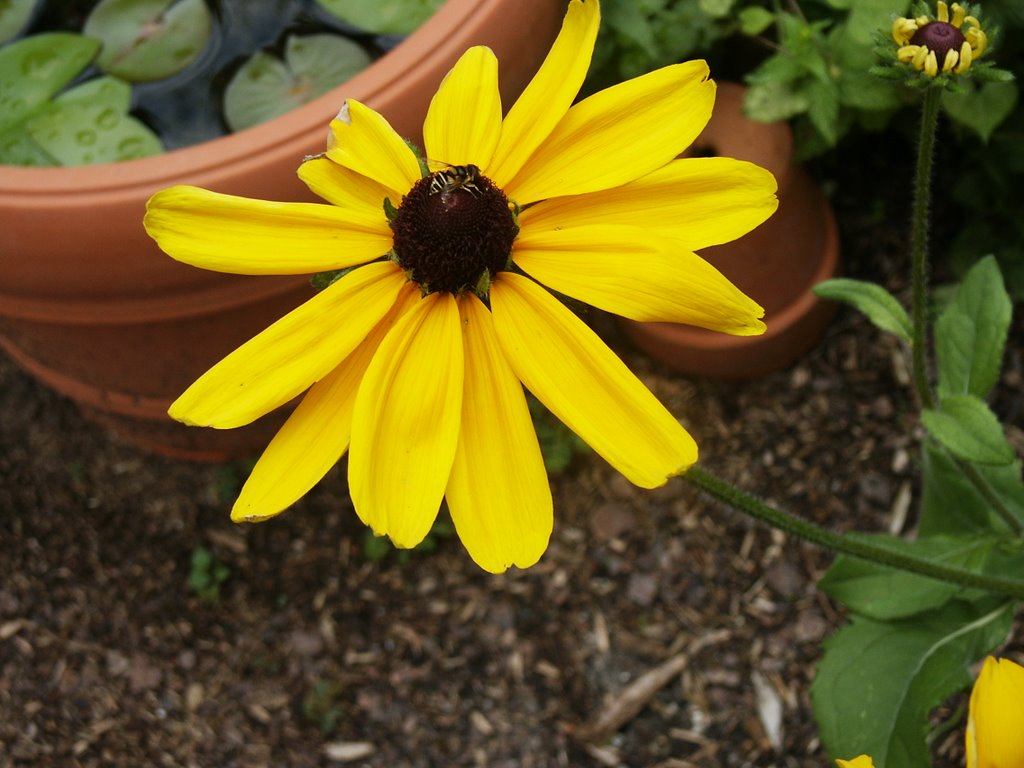
Black-Eyed Susan (Rudbeckia fulgida) is yet another popular, sun-loving perennial that makes a good cut flower. It tolerates poor soil and drought and blooms from summer into fall across a wide range of climates. ‘Goldsturm’ grows about three feet tall and was honored by the Perennial plant Society as the 1999 Perennial Plant of the Year.

Autumn Joy Sedum must be one of the hardiest plants in my garden and, though we don’t get the bright flowers that appear in cooler climates, there are flowers still, and this sedum is certainly worth growing for its foliage. There are hundreds of plants in the huge and varied sedum genus. Some are low-growing. Others are upright. Most are succulent with thick, fleshy leaves. The best thing about the sedums in my garden, I think is the fact that in the deep, dreary winter when the garden is bare, you happen upon a pot of them and already the new baby plants have begun their spring journey.

Salvia leucantha, or Mexican Bush Sage has tall, deep purple flower spikes that don’t show up until late in the summer. It’s worth the wait, however, and this handsome tender perennial graces gardens from the upstate, where it’s not likely to survive the winter to Charleston, where it probably will. In my salvia madness period in early spring, I bought a pot and left it on the west side of the house where it doesn’t get much water. It’s hanging in however, and will burst forth any day and last until frost. I might have sheared it back a few times during the summer to get lusher blooms.

So, at least my more resilient flower children have nearly made it through another Aiken summer that seems to be getting hotter as we plow into September. Maybe when it cools off I will become a more attentive mother.

Wednesday, August 16, 2006

Aiken's Weather Suits Tung to a T


Aiken city horticulturist Tom Rapp tells me he had several problems when trying to replace the Bradford Pear trees planted up the Laurens Street Hill near Aiken's famous fountain. Bradford Pears, though quite eye-catching, tend to split as those trees did, so he didn’t want to plant more of them. Bell South had a large line under the planting strip and recommended that the city not plant any big trees there.

Tom searched for something unusual that would be attractive, fairly drought tolerant and hardy and that could take whatever stress might come from standing so near the street. Aleurites fordii, or Tung Oil tree, was his pick, and that it what is planted there today. Though they look a little scrawny now, they promise to spiff up that spot come spring.

According to Floridata, a website that gives in-depth information about many flowers, trees and shrubs that grow in Florida, Tung Oil trees grow best where summers are long and hot and temperatures are consistently warm day and night throughout the growing season. Aiken sounds like the perfect spot.

The Tung Oil tree is a spreading round-crowned deciduous tree that should grow to about twelve to twenty feet tall. If you’ve ridden by, you can see the leaves are large (3-5 inches) and heart shaped. In the spring, before the tree leafs out, we can expect to see creamy colored blooms, growing in clusters.

After they’re pollinated by honeybees, the female flowers develop into two to three inch round fruit that contains nut-like seeds. The oil from these seeds is used as a waterproof coating for wood and as a drying agent for paints and varnishes. It has many other industrial uses.

Tung Oil trees like slightly acidic soil, thoughthey will tolerate a wide range of soil types.

All parts of the tree, especially the fruit, are toxic.

Like the Bradford Pear, this Tung Oil tree promises a handsome display to announce the arrival of spring.

On a visit last year at the home of Gloria Farmer, mother of well-known South Carolina horticulturist Jenks Farmer, Jenks cut open a Tung Oil fruit to show the valuable seed inside.

Friday, August 11, 2006

Not So Far from the Madding Crowd


St. Thaddeus Church and the churchyard surrounding it stand between busy U.S. Highway 1 and a spot that is, for nine months a year, the Mead Hall school playground. It doesn’t sound like a spot you would go for quiet meditation. Nevertheless, it is a peaceful place. Old live oak, cedar, and magnolia trees tower over dogwood, camellia, an assortment of colorful annuals, perennials, and an historic graveyard.

Some of the graves and some of the trees in the churchyard predate the Civil War. The flowers are new, however, and for this our congregation can thank the efforts of Tim Garvin. Tim spends hours of his time all year, tending these beds, experimenting with plants that will thrive in conditions that are sometimes less than ideal.

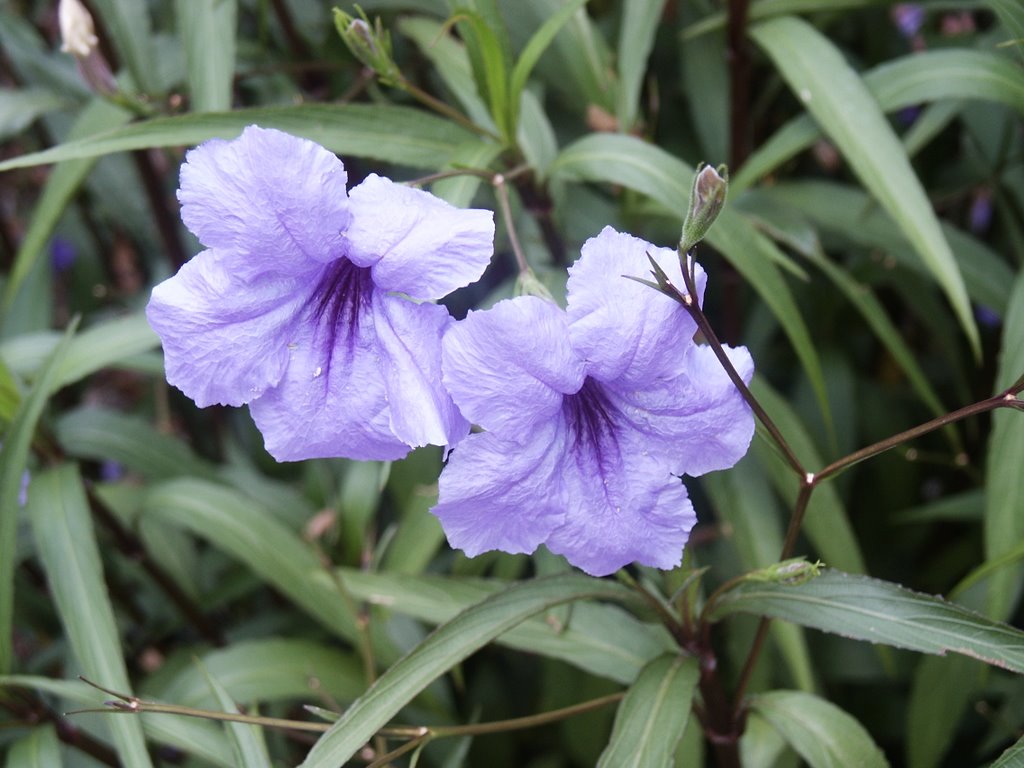
Soft purple Mexican petunia waves its willowy leaves along the drive.

Bengal tiger canna dances behind the brick wall.

Melampodium blankets the bed near the ramp that leads to the front doors.

Friday, August 04, 2006

By the Sea, By the Sea


You can drive from Aiken to Folly Beach, South Carolina in less than three hours. Only one stoplight slows you down after you get out of town, through Salley and North, past Bull Swamp and onto I-26 north of Orangeburg. It's a peaceful ride, skirting downtown Charleston and across the wide and easy James Island connector, out Folly Road to the Island.

Sea birds, outboard motors, and a violent Saturday night thunderstorm were just about the only sounds we could hear from the deck of the condo that overlooked the Folly River.

Oleander, not native to the area, but very much at home here, lines the causeway from the mainland, as it lines many of the roadways near the southeast coast. Other wildflowers catch you eye as well, if you risk jumping out of the car for a quick shot.

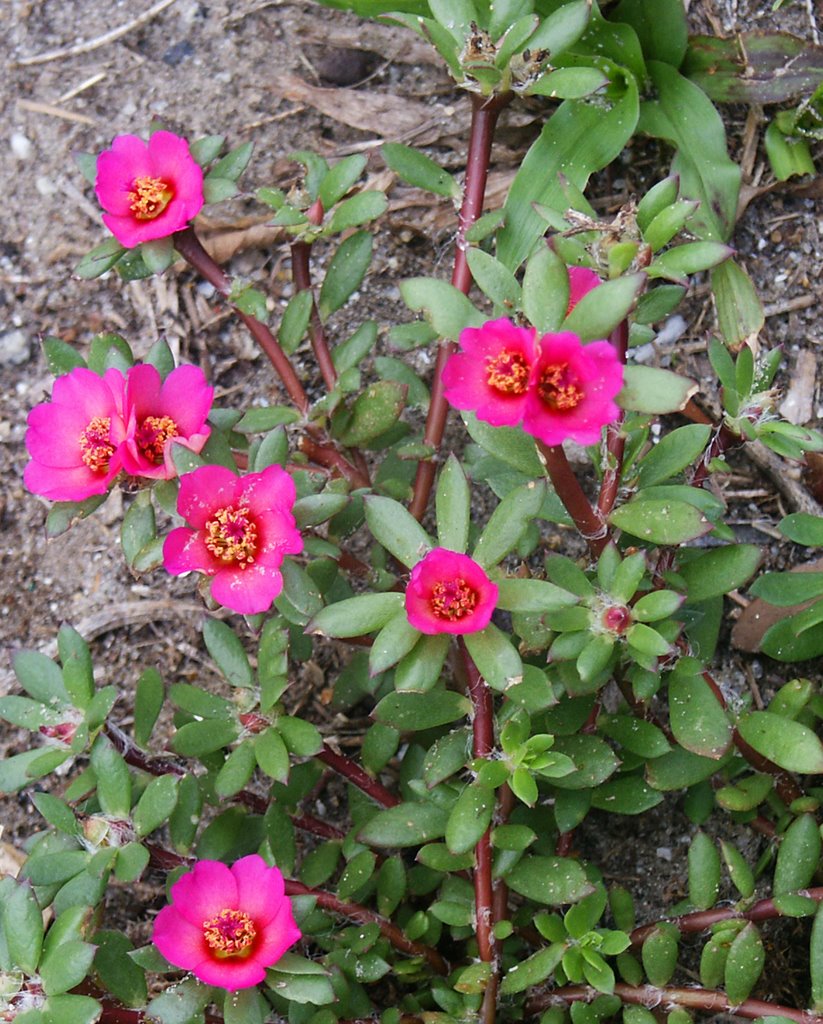
Can anyone identify this dainty pink flower I found growing beside the road?

Tuesday, August 01, 2006

'Spellbound' has me Spellbound


I shot a quick photo of the 'Spellbound' Rose blossom before we left town on Friday and it and the remaining blooms succumbed to the heat. This is a perfectly beautiful rose I added to my garden this spring and so far it's been quite happy there. 'Spellbound' is a hybrid tea with thick satiny petals and delicious coral blossoms. So far it's been resistant to black spot and keeps coming back despite the heat. The weather this week, with temperatures hovering around 100, will put it to the test.

Tuesday, July 25, 2006

It's a bird, It's a plane, It's Supertunia

Two shades of Coleus and Supertunia Vista 'Bubblegum' can take even Aiken's steamy summers

Aiken's round intersections sometimes present problems to drivers who are new to the area. They also present great opportunities for City Horticulturist Tom Rapp and his crew to display their talents, often showcasing plants new to the market. 'Black Pearl' ornamental pepper and Supertunia Vista 'Bubblegum' are two hot new plants for this season. While you're waiting to "left turn yield," have a close look at these lush beds.

With so many beds to tend, Tom includes plants that are heat and drought tolerant and low maintenance. He's also careful to make sure the soil is everything it should be. Every year the landscaping crews replace the existing soil with 3-4 inches of Bricko Farms' "Aiken Mix."

'Black Pearl' Ornamental Pepper

Saturday, July 22, 2006


I do love roses and have planted many rose bushes over the years, though I'm afraid some of the serious rose growers I know would be horrified at my technique - or lack of it. I plant roses the way you're supposed to, adding organic matter and lime and superphospate and Epsom salts for strong stems. I spray about every two weeks, add a systemic fertilizer that takes care of diseases, and, now that I have irrigation, I water my roses regularly. But that's about it. I don't inspect my roses daily for Japanese beetles and blackspot, and in some cases I plant too many other things too close to the roses so the air can't circulate well enough.

Here's the deal. For a rose to do well in my garden, it's got to be tough. For as long as they last, I'm going to post a photo of my favorite easy-to-grow Rose of the Week. This week's winner was one of the 1994 All American Roses Selections, with bright yellow petals and dark green foliage. It grows upright to five feet tall with four inch musk scented flowers. Introduced by Jackson and Perkins, this week's award goes to 'Midas Touch.'

This rose made the Augusta Rose Society's "easy care roses" list. For lots of good advice for growing roses in the steamy South Carolina midlands, follow the link to their website.

If you have a favorite easy care rose, please post a comment below.

Thursday, July 20, 2006

Knock Outs™ and Sunpatiens™ - worthy of the hype?


Knock Out™ Roses have been around our gardens for several years now. Shrub roses bred for their winter hardiness, drought tolerance, and resistance to disease, they appear to be the darling of the humid southern garden. Knock Outs™ come in three colors, red, pink, and blush, and they get my vote since they're blooming beautifully in the middle of steamy July.


Tropical Orange Sunpatiens™ seems to tolerate the afternoon sun in my garden, as long as I water it everyday. But I'm not sure that other New Guinea impatiens wouldn't do the same. It has lasted well though, just as long as we don't run out of water.

Friday, July 14, 2006

Could I borrow a cup of bandwidth?

We arrived home yesterday, after a visit with our brand new grandson to find that our cable was out. A nonfunctioning cable is for us a double whammy - no TV and no internet.

Having spent six hours in the car together over the last two days, we were not interested in getting to know each other better during this unassigned time. We know each other well enough for the time being. We could read, but we usually do that anyway, later.

We were able to entertain ourselves briefly with the satellite radio. Hank watched an old DVD, but I had news to get out and pictures of the most adorable baby ever born to show the world. I was suffering world wide web withdrawal.

We called our neighbor across the street to find out if his cable was out too, so we would know if it was our problem alone. His cable was working fine he said, "but hey, you want to surf? Get on my wireless connection! I know it'll work, because when my connection got hit by lightning, I got onto yours."

Hmm. Imagine that. You can get on your computer in your house and with no wires or anything (hence the name - wireless) you can get service using your neighbor's connection. It worked perfectly. He was out for the evening so I didn't slow him down any. I sent photos of the new baby to everyone I thought might be the least bit interested, and everybody was happy.

Glomming on to someone else's internet connection with the intention of never paying for one yourself is illegal of course. You can be caught and prosecuted for it, and, just like you wouldn't steal a cup of sugar, you wouldn't steal a connection someone else has paid for. But the cable guy, who fixed it the next morning after we decided the cat pulled the connection loose, assured me it was OK this time.

I always knew I liked this neighborhood. From the day we came to town thirty years ago, I thought I wanted to live here. I pictured neighborhood picnics and the kids playing baseball and a glass of wine in the garden with old friends, but who'd have imagined then, that someday we'd move in and be able to share something invisible with our neighbors? That we'd be using each other's electromagnetic waves.

Maybe we should take up a sport.

Thursday, July 13, 2006

'Workman' is the Perfect Name for this Aiken Gardener

Denny Workman spends 12 hours a day working in his spectacular shade garden on the south side of Aiken. This is just one of the many delightful vistas you can enjoy on his nearly two acre spread. Hostas, like this 'Tattoo,' share the space with hydrangeas, magnolias, ferns, pine, oak, and hickory trees. Even sun sensitive rhododendrons survive the Aiken heat in this shady spot.

Denny is also an artist. He created this magnolia blossom from scraps of copper roofing.

Monday, July 10, 2006


Life is just a bowl of Okra.

Fuzzy, green bullet-shaped Okra, Abelmoschus esculentus, is a cousin to the Hollyhock and Hibiscus, with a flower that's attractive as vegetables go.

A half cup of boiled okra, if you can stand to eat it that way, is only 18 calories. It's low in Saturated Fat and Cholesterol. It is also a good source of Protein, Riboflavin, Niacin, Phosphorus, Potassium, Zinc and Copper, and a very good source of Dietary Fiber, Vitamin A, Vitamin C, Vitamin K, Thiamin, Vitamin B6, Folate, Calcium, Magnesium and Manganese.

Fry it up in a flour and cornmeal batter, and you've multiplied the calories by a factor of 10 or so and you can forget about the low in fat designation, but team it up with a bowl of butterbeans or crowder peas and a couple of juicy red tomatoes and you can sit down and take a bite out of summer.

Saturday, July 08, 2006

Question: What's better than your own vegetable garden?

Answer: A neighbor with a vegetable garden!

A fifth of an acre under a canopy of live oaks and sweetgums is not a good place for a tomato garden. Our neighbor, Mr. Wade, an ex-banker with roots in the country, has a yard not unlike ours, but he has a farm, and on that farm he grows the sweetest tomatoes and the tenderest squash and cucumbers and cabbage and some other things we haven't even tried yet. About twice a week he arrives from Salley with the back of his truck full. All we have to do is walk around the hedge that separates our driveways and fill up a bag.

When I was growing up outside of Atlanta, our next door neighbor Mr. Lingerfelt had a garden like Mr. Wade's in the lot he had bought behind his house. All year he grew vegetables that he shared with us. The difference was - he charged. He also offered an occasional taste of squirrel stew. We declined.